
$4.6tn
settles on Fedwire each day. More than half of that value settles in the final third of the day.
Federal Reserve.
FNA Sampo: Secure Automated Multi-Party Optimization
Sampo cuts the intraday liquidity banks need by coordinating when they submit large-value payments. Each bank keeps every decision. No netting, no change to the RTGS.
2 hours
earlier on average for each payment, when banks send most of their payment intents before the opening.
49% less
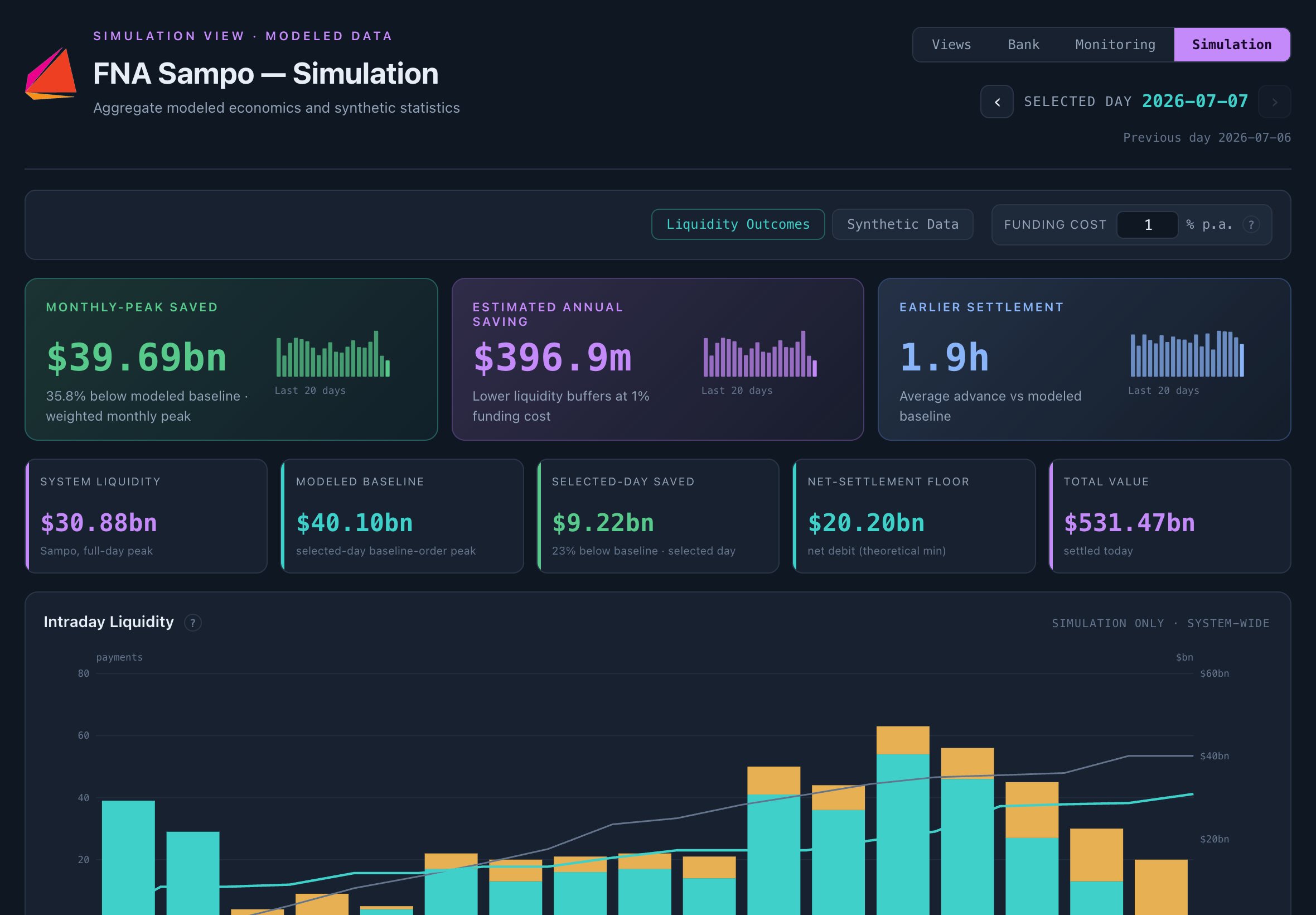
peak net debit for the same payments: $55bn across five large banks, simulated.
63% less
value left to the last hour of the day, so an outage or a late payment affects fewer payments.
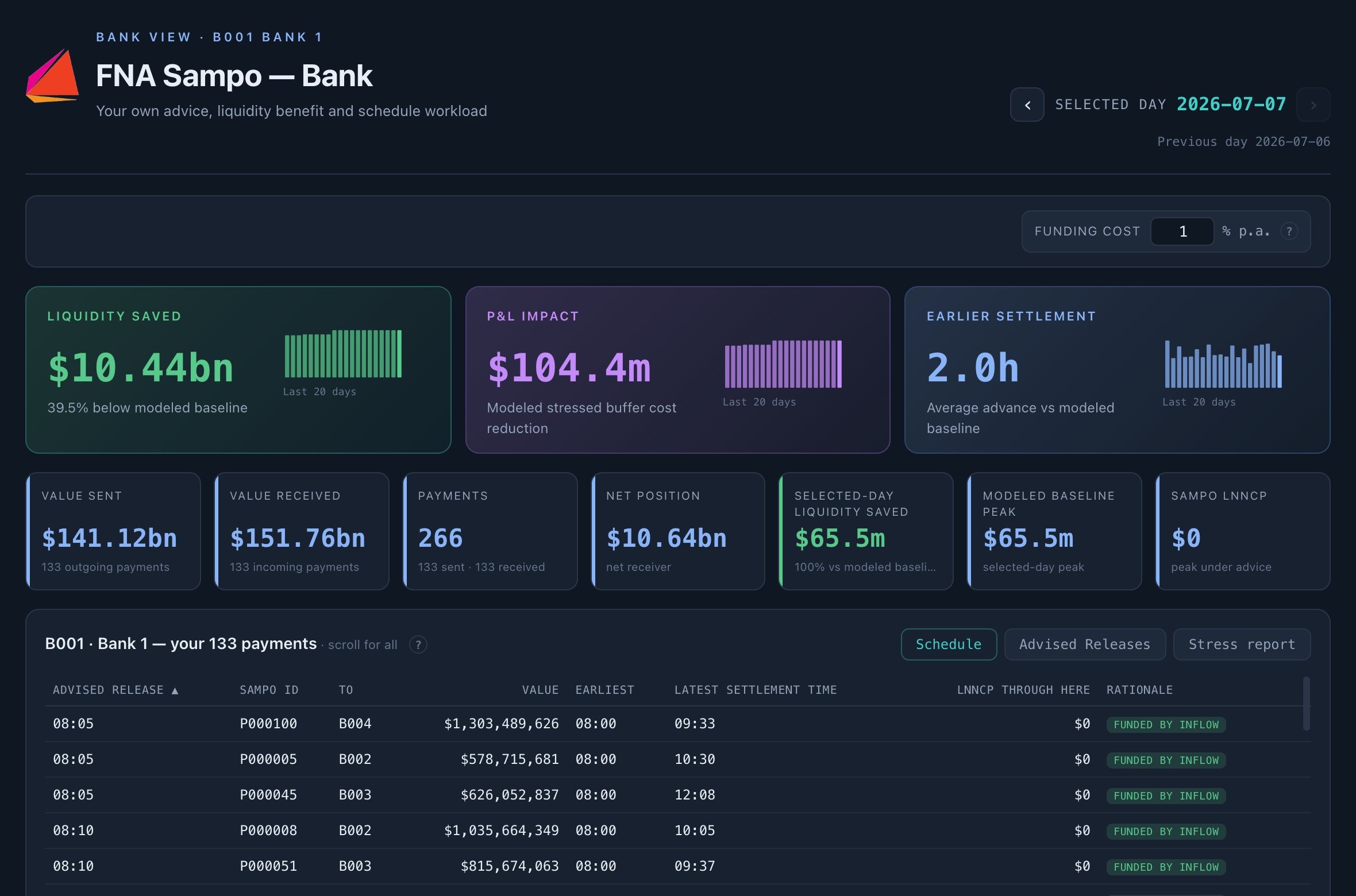
The Bank view: one bank's advice and liquidity benefit. The evidence
The problem
A bank knows most of its own payments at the start of the day. Around 70% of large-value payments are known by then. What the bank does not know is when other banks will send the payments it is due to receive.
Without that information, the bank has two options for each outgoing payment: fund it from its own reserves or collateral, or hold it until incoming payments arrive. Banks hold payments and keep buffers against the uncertainty.
The information the bank lacks exists: other banks have it. One bank's outgoing payment is another bank's incoming payment. No bank has all of it, and no bank can act on it alone.
Sampo uses the payments that the banks in the cohort already know, and advises each bank when to submit its own payments, so that incoming payments arrive in time to fund outgoing ones. No bank receives another bank's payment data.
$4.6tn
settles on Fedwire each day. More than half of that value settles in the final third of the day.
Federal Reserve.
70%
of large-value payments are known at the start of the day.
20%
lower intraday liquidity for CHAPS settlement banks after the liquidity-saving mechanism, about £4bn a day, with no loss of throughput.
Bank of England.
22%
less liquidity from reordering payments alone, on about $1.7 trillion of daily CHIPS payments.
FNA analysis of CHIPS data for The Clearing House.
What it is worth
Enter your monthly peak net debit and your cost of liquidity. The calculator shows the liquidity Sampo releases and its annual value.
What Sampo is
Sampo is a compute-and-advice service. It is not part of settlement and holds no funds.
For central banks and supervisors
Liquidity-saving mechanisms are treated as financial stability infrastructure as well as efficiency tools. FNA shows with Sampo that a cohort of banks can obtain that benefit without a change to the RTGS.
When banks hold payments until late in the day, value concentrates in a short window and queues build. An outage, a late payment or a stressed bank then affects more payments. Earlier, steadier settlement reduces that exposure.
Reserves held for intraday payments have an opportunity cost, and collateral pledged for intraday credit cannot be used elsewhere. Lower intraday peaks mean the same payments settle with less of both.
Sampo is advisory. The central bank keeps the RTGS as it is, settlement stays final in central bank money, and oversight roles do not change.
Sampo views
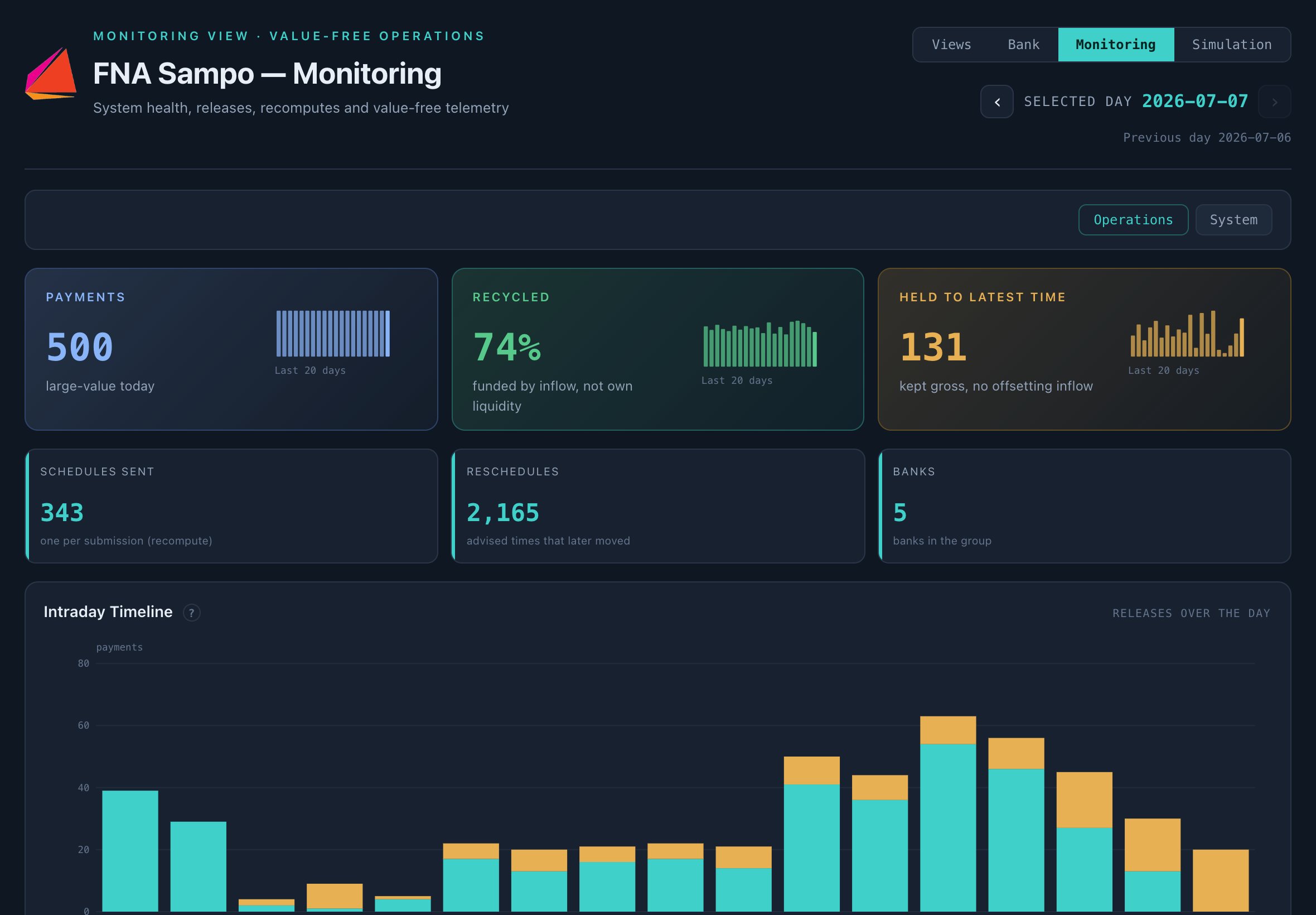
A bank receives its own advice and benefit figures, as in the Bank view above. Monitoring receives system health data without amounts. The Simulation view shows the outcome for the whole cohort. All three screens show results from a synthetic five-bank model.
How it works
Below: one model day, replayed. In Sampo's design, independent compute parties compute the payment schedule together, and each sees only shares of the amounts.
Diagram of Sampo's design, with banks, three compute parties and monitoring. Each bank sends payment intents to the compute parties. They compute the payment schedule together and send each bank its advice.
Each bank sends Sampo a payment intent for each of its upcoming large-value payments. A payment intent is not a payment instruction.
Sampo computes a payment schedule with Sampo's rule, parts of which are patent pending. Today Sampo runs on payment data in the clear. In Sampo's design, independent compute parties compute the payment schedule together, and each sees only shares of the amounts.
Sampo sends each bank advice for its own payments only.
The bank submits each payment to the RTGS when Sampo advises it, or at its own time, using its existing systems. The RTGS settles it as today.
Sampo updates the payment schedule every minute from the payment intents sent so far and advises which payments to submit now. Advice is valid for one minute. The bank submits a payment that Sampo does not advise early at its own time.
Sampo compares actual submission times with its advice and reports the liquidity saved. It uses submission and receipt times, not amounts.
Work with Sampo
For banks, central banks and RTGS operators
We replay your agreed historical or shadow flows and compare your bank's peak without Sampo with its peak with Sampo. You get your own bank's figure, not a network average.
Discuss a pilotFor researchers and agent developers
AI agents act as banks in a simulated payment day. Each agent sends its payment intents to Sampo, receives Sampo's advice and submits to a simulated RTGS. Agents connect over the Model Context Protocol (MCP) or an HTTP API. Synthetic data only.
About the AI SandboxWhy FNA
FNA built and operates the world's first national anti-scam utility: Malaysia's National Scam Response Centre, live across 48 institutions.
FNA's review of CHIPS data for The Clearing House measured the opportunity from reordering payments on about $1.7 trillion of daily payments.
FNA works with RTGS operators, financial market infrastructures and regulators worldwide.
In Sampo's design, independent compute parties compute the payment schedule together, and each sees only shares of the amounts. Payment amounts would then stay confidential from the service operator, every compute party and every other bank.
Selected FNA project experience
FNA has delivered analytics and simulation projects with central banks, payment-system operators and industry bodies.
 Bank of England
 The Clearing House
 UK Finance
 CLS
CLS Monetary Authority of Singapore
 Payments Canada
Project Ellipse
FNA supported the BIS Innovation Hub Singapore Centre and the Monetary Authority of Singapore, with the Bank of England and others, on a prototype platform for supervisory data.
BIS project reportIndependent CHIPS review
FNA assessed CHIPS' liquidity efficiency using payment data and simulations of alternative settlement arrangements.
Project announcementCHAPS liquidity study
FNA modelled how pre-opening payment compression could lower intraday liquidity for CHAPS banks.
Read the case studyFNA's wider collaborations include the Central Bank of the UAE, Saudi Central Bank and SWIFT.
Research
Morten Bech and Kimmo Soramäki formalised gridlock resolution in interbank payment systems in 2001. That work describes the class of mechanism that saves liquidity in CHAPS today.
Why liquidity use is uncoordinated, what regulation requires, and why coordination also improves resilience.
ReadHow the modeled results are produced and what they leave out.
ReadThe paper that formalised how to resolve gridlock in RTGS payment queues.
SourceThe research library: FNA research, briefing papers and the literature
Where Sampo stands
Sampo is entering a USD shadow-data pilot on real bank flows. Design partners measure the saving on their own payments first.
Or email Phillip Straley at phillip@fna.fi